
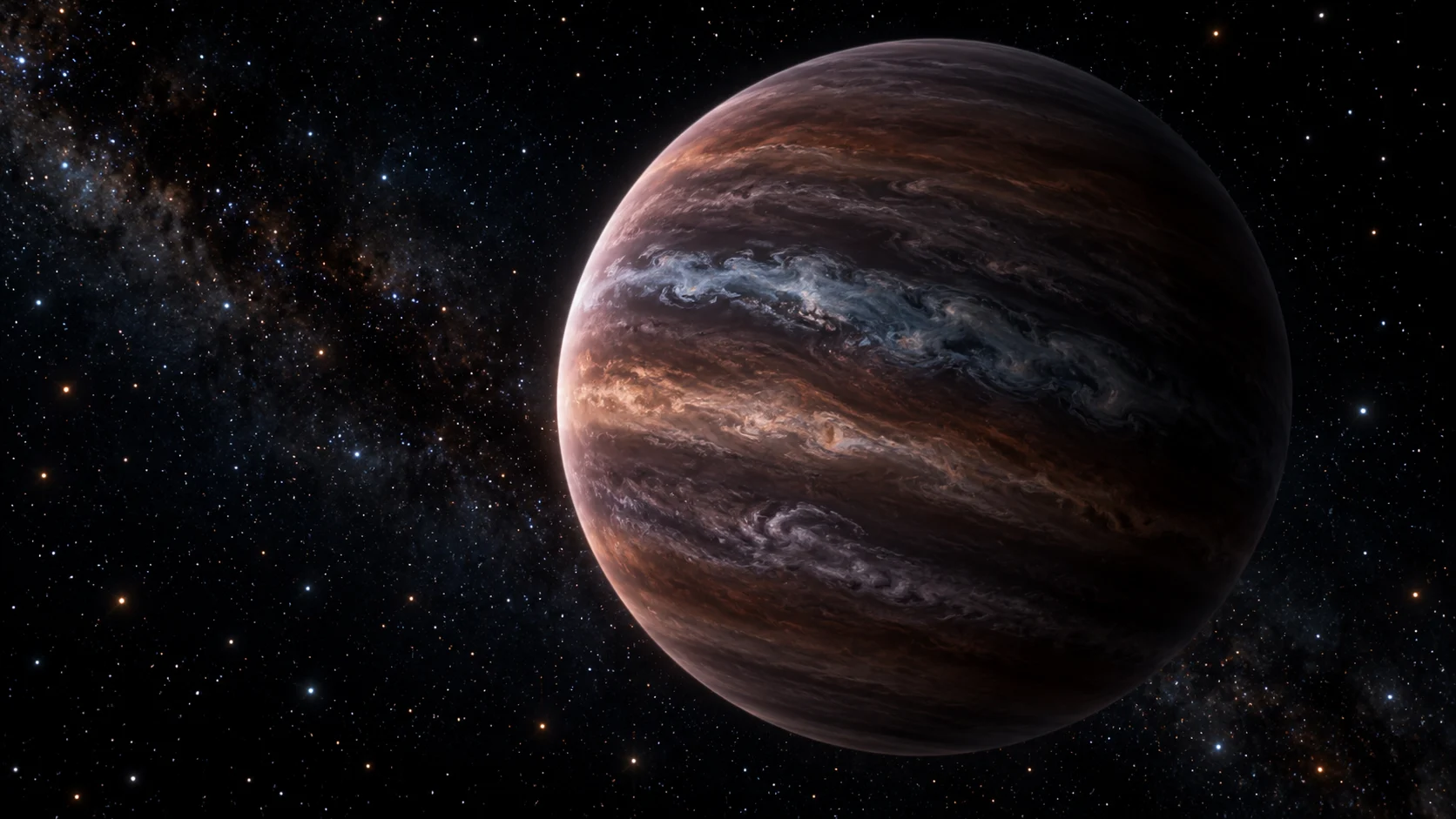
wise 0855 brown dwarf exoplanet: Astronomers using NASA’s James Webb Space Telescope have uncovered new evidence of changing weather on WISE 0855, one of the coldest known brown dwarfs beyond our solar system. New observations reveal that water clouds in its atmosphere appear to change thickness as the object rotates, while gases from deeper atmospheric layers rise and fluctuate.
The findings, reported in September 2026 and highlighted by researchers at the University of Arizona on October 8, provide a more detailed view of atmospheric activity on this unusual celestial object. The research could also help scientists understand the weather, cloud formation, and atmospheric chemistry of giant planets outside our solar system.
What Is WISE 0855?
WISE 0855, formally known as WISE J085510.83-071442.5, is a nearby substellar object located approximately 7.5 light-years from Earth. It was identified in 2014 using observations from NASA’s Wide-field Infrared Survey Explorer and Spitzer Space Telescope.
WISE 0855 belongs to a category of exceptionally cool brown dwarfs known as Y dwarfs. Brown dwarfs are often described as objects between stars and planets because they do not have enough mass to sustain the hydrogen fusion that powers ordinary stars. The lowest-mass brown dwarfs can share several characteristics with giant planets, including similarly cool temperatures and complex atmospheric conditions.
Although WISE 0855 is sometimes discussed alongside free-floating planets and exoplanets, it is classified as a brown dwarf rather than a confirmed exoplanet orbiting a star. Because it does not have a bright host star shining behind or around it, astronomers can study its faint atmospheric glow without the same level of interference that affects observations of many exoplanets. wise 0855 brown dwarf exoplanet
How NASA’s James Webb Space Telescope Studied the Object
A research team led by Brittany Miles of the University of Arizona used Webb’s Near-Infrared Spectrograph, known as NIRSpec, to monitor WISE 0855 for approximately 11 hours. The telescope collected spectra at roughly 15-minute intervals, covering infrared wavelengths between 2.87 and 5.27 micrometers.
A spectrum separates incoming light into different wavelengths, allowing scientists to identify chemical signatures and investigate temperature changes in an object’s atmosphere. By observing repeatedly rather than collecting only a single snapshot, researchers could compare how individual molecular features changed over time.
This approach helped the team distinguish the effects of atmospheric clouds, temperature variations, and chemical activity. These processes can produce overlapping signals in ordinary observations, making it difficult to determine which physical process is responsible for a change in brightness.
Water Clouds Appear to Change as WISE 0855 Rotates
One of the study’s most important findings is evidence that water-cloud coverage in WISE 0855’s atmosphere is uneven and changes over time. As the brown dwarf rotates, different atmospheric regions move into view. Those regions appear to have varying cloud thicknesses and temperatures, creating changes in the infrared spectrum detected by Webb.
The results provide the first direct confirmation that water clouds on another world beyond our solar system can change in thickness over time. While earlier observations had suggested the possibility of water or water-ice clouds on WISE 0855, separating cloud signals from temperature and chemical variations was challenging.
The latest analysis moves beyond identifying the possible presence of clouds. It provides evidence that cloud conditions vary across the object and that these variations can be distinguished from other atmospheric processes. The researchers can therefore investigate atmospheric weather in much greater detail than was possible with older observations.
Carbon Monoxide and Phosphine Reveal Activity Beneath the Clouds
The observations also detected changing signatures associated with carbon monoxide and phosphine, a phosphorus-containing gas. At some wavelengths, the changing carbon monoxide absorption showed peak-to-peak variations of up to 10 percent.
The researchers found that variations in carbon monoxide and phosphine were correlated. Their analysis suggests that atmospheric mixing brings gases from deeper, hotter layers toward the observable upper atmosphere. This process, known as disequilibrium chemistry, can maintain chemical abundances that differ from what would be expected if the atmosphere were in chemical equilibrium.
Similar processes occur in giant planets such as Jupiter, where convection transports material through different atmospheric layers. Seeing these chemical signals change over time on WISE 0855 gives astronomers a new way to investigate how temperature, atmospheric circulation, and chemistry interact on extremely cold worlds.
Why the New Findings Matter for Exoplanet Research
WISE 0855 has an estimated effective temperature of around 265 kelvin, or approximately minus 8 degrees Celsius. Despite this temperature, its atmosphere can still support complicated cloud behavior and active chemical processes. It is therefore a valuable natural laboratory for investigating the physics of cold gas-rich objects.
Earlier research using Webb’s Mid-Infrared Instrument did not find clear spectral evidence of water-ice clouds in the dataset it analyzed. The newer time-series study uses a different observational approach, tracking changes in specific spectral features over several hours. Its evidence for patchy, changing water clouds helps address a question that had remained uncertain, although further observations and atmospheric modeling will still be important.
The findings are relevant to exoplanet research because brown dwarfs and giant planets can share similar atmospheric temperatures, chemical ingredients, and cloud-forming processes. Studying a relatively nearby object without the glare of a host star helps scientists test models that may eventually be used to interpret the atmospheres of distant gas-giant exoplanets.
What Astronomers Will Investigate Next
Further observations with the James Webb Space Telescope could help researchers determine how quickly WISE 0855 rotates, map its changing atmospheric features more precisely, and establish how its clouds and chemical gases vary at different depths. Longer monitoring campaigns could also reveal whether the observed patterns repeat consistently over multiple rotations.
The discovery does not establish that WISE 0855 is habitable or that liquid water exists there. The evidence concerns atmospheric water clouds and changing chemical signatures, not life. Instead, the study offers a valuable new look at how weather and atmospheric chemistry operate on a cold, planet-like object in our cosmic neighborhood.
As astronomers continue to use Webb to study faint and distant worlds, WISE 0855 demonstrates why monitoring atmospheric changes over time can be just as important as identifying the chemicals present in a single observation.