
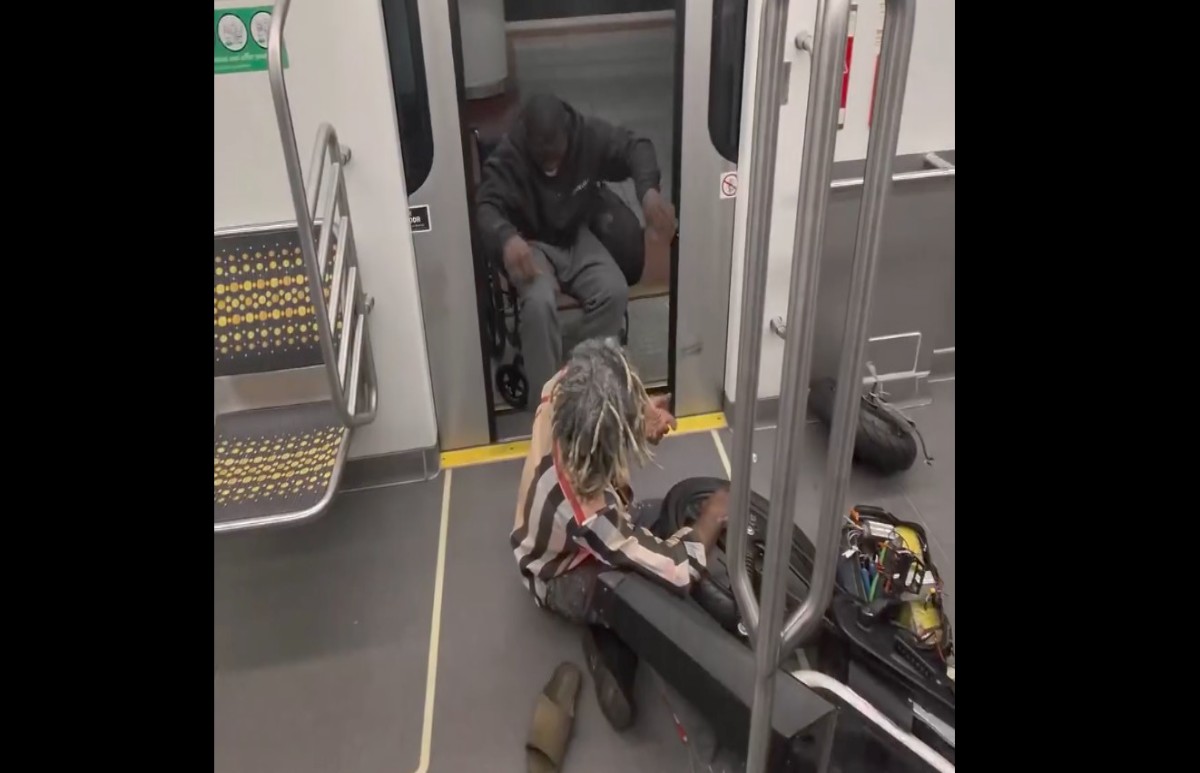
LOS ANGELES — A shocking video capturing a violent altercation on a subway car has gone viral online, sparking intense public debate regarding public transit security, municipal crime statistics, and bystander behavior in major metropolitan areas.
The footage shows an individual utilizing a wheelchair launching a physical assault against another subway passenger. The confrontation quickly escalates, leaving the victim visibly incapacitated on the floor of the train car. Moments later, the aggressor returns to the wheelchair, utilizing one foot to continuously kick the individual as they attempt to regain consciousness.
Throughout the recorded duration of the incident, surrounding passengers appear to watch the event unfold without physical intervention, highlighting a growing trend of public passivity during urban conflicts.
Location Dispute: Los Angeles vs. New York Infrastructure
While early social media speculation misidentified the setting due to ongoing public anxiety surrounding northeastern transit lines, local commuters and observers quickly corrected the record. Witnesses noted structural and interior design elements—including the seating layout and window framing—consistent with the Los Angeles Metro rail system rather than the New York City subway infrastructure.
A man in a wheelchair attacks another subway passenger and knocks him out cold.
Then he sits back down in his wheelchair and uses his good foot to keep kicking the guy as he starts to come to.
Nobody steps in. The rest of the car just watches it happen.
This isn't a one-off.… pic.twitter.com/1jdPT0KUbu
— Katie K USA (@KimKatieUSA) October 10, 2026
The confusion highlights how easily viral footage can be misattributed to different cities, amplifying generalized fears about public transportation safety across the United States.
Transit Crime Data Under Scrutiny
The distribution of the footage has amplified ongoing discussions regarding crime trends within public transportation networks. High-profile incidents frequently fuel the public perception of rising subterranean violence, prompting authorities to release official data to clarify the scope of transit safety challenges.
Recent statistical disclosures from major transit hubs highlight the persistent nature of security issues facing large-scale transit operations:
| Metric | Statistical Details & Trends |
|---|---|
| Felony Assault Stability | Official reports indicate that high-level offenses remain flat. Law enforcement data from the NYPD Transit Bureau noted 523 felony assaults from January through November 2025, virtually identical to the 527 offenses recorded during the same timeframe in 2024. This averages to more than 10 felony assaults underground per week. |
| Robbery Surges | Despite stability in overall assault numbers, localized spikes in property crimes continue to plague underground systems. Comparative reporting submitted to metropolitan transit authorities revealed that subway robberies jumped 51.7% in January compared to the previous year’s baseline. |
The Dilemma of Bystander Inaction
Beyond the immediate violence, the viral clip has drawn severe criticism for the apparent passivity of the onlookers sharing the car. The phenomenon, often studied by sociologists as the “bystander effect,” remains a recurring point of contention during public altercations.
Security experts and law enforcement agencies generally advise citizens against direct physical intervention during active conflicts due to the unpredictable risk of escalating violence or the potential presence of concealed weapons. However, the complete absence of immediate verbal intervention or visible efforts to summon emergency services in modern viral recordings continues to drive deep cultural anxiety regarding community safety and mutual aid in urban environments.