
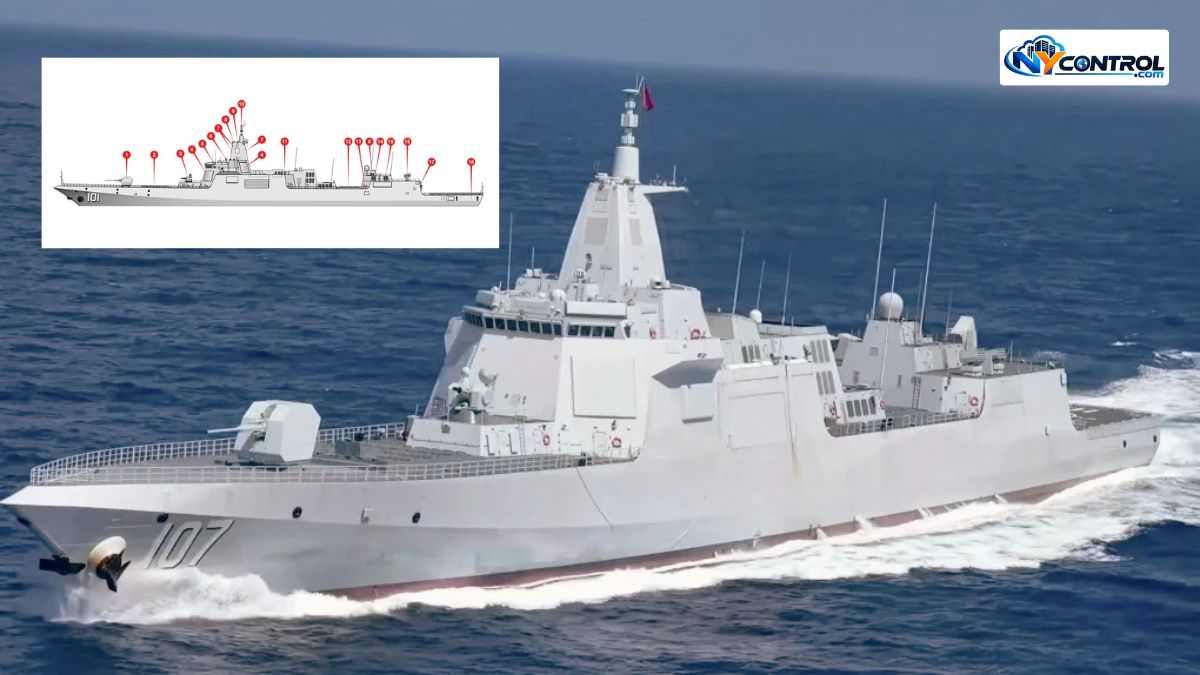
BEIJING — In a significant development highlighting the ongoing naval friction in the Indo-Pacific, Chinese state media and military personnel have claimed that a foreign warship suffered a complete loss of power and radar capabilities while shadowing a People’s Liberation Army Navy (PLAN) Type 055 destroyer. The incident, which reportedly took place in the South China Sea, has sparked widespread speculation regarding the electronic warfare capabilities of China’s most advanced surface combatant.
The Engagement in the South China Sea
According to recent accounts from a Chinese crew member aboard a Type 055 destroyer, a foreign vessel attempting to conduct close-range reconnaissance and track the Chinese warship abruptly lost propulsion, power, and radar systems. The blackout reportedly lasted for nearly half an hour. While Beijing did not officially name the foreign vessel, independent defense analysts and military watchdogs strongly speculate that the ship involved was a United States Navy Arleigh Burke-class destroyer, potentially the USS Benfold.
During a broadcast on China Central Television’s military channel, a Chinese sailor recounted the tense standoff. When asked if the crew felt nervous during the close encounter, the sailor confidently stated that the crew and equipment operated flawlessly, adding that as long as the foreign vessel was within missile range, the Type 055 could confidently dominate the engagement. The foreign vessel was eventually driven away after the Chinese crew followed protocol to secure the area.
Electronic Warfare and The Type 055’s Capabilities
The reported blackout of the foreign warship has brought the electronic warfare (EW) suite of the Type 055 destroyer back into the global spotlight. Known by NATO as the Renhai-class cruiser due to its massive size and heavy armament, the Type 055 is widely considered one of the most capable surface warships in the world. It is equipped with dual-band active electronically scanned array (AESA) radars and highly integrated mast sensors designed to detect stealth targets and disrupt enemy communications.
If the claims of an electronic systems kill are accurate, it suggests that the PLAN has made significant leaps in non-kinetic engagement tactics. Defense experts note that the Type 055’s ability to potentially “turn off” or severely jam the systems of a shadowing vessel demonstrates a highly sophisticated, next-generation electronic warfare capability that rivals or even surpasses current Western equivalents.
Expanding Fleet and Rising Tensions
This incident comes at a time when China is rapidly expanding its blue-water naval capabilities. The PLAN currently has at least 10 Type 055 destroyers either active or in advanced stages of preparation. Recently, the newly commissioned Type 055 destroyer Dongguan completed its first comprehensive maritime training in the East China Sea, featuring single-vessel and joint operation drills. Furthermore, China continues to ramp up production at major shipyards in Dalian and Shanghai.
The Type 055 is heavily armed, featuring 112 vertical launch system (VLS) cells capable of firing long-range anti-ship cruise missiles, anti-air missiles, anti-submarine torpedoes, and the highly publicized YJ-21 hypersonic anti-ship ballistic missile. Additionally, the vessel features dual helicopter hangars, allowing for expanded anti-submarine operational coverage with advanced Z-20 helicopters.
Strategic Implications for the Indo-Pacific
The alleged confrontation underscores the high-stakes environment in the South China Sea, a heavily contested waterway where the US Navy routinely conducts Freedom of Navigation Operations (FONOPs). The US Navy has historically described close encounters with Chinese vessels as “unsafe and unprofessional,” while Beijing consistently characterizes foreign naval presence in the region as provocative reconnaissance.
As China continues to project power further into the Pacific and integrate its growing fleet of Type 055 “super destroyers” into carrier strike groups, military analysts warn that close-quarters engagements and electronic warfare tests between rival powers will likely become more frequent. For now, the latest standoff serves as a stark reminder of the shifting naval power dynamics and the rapid technological advancements defining the modern naval battlespace.