
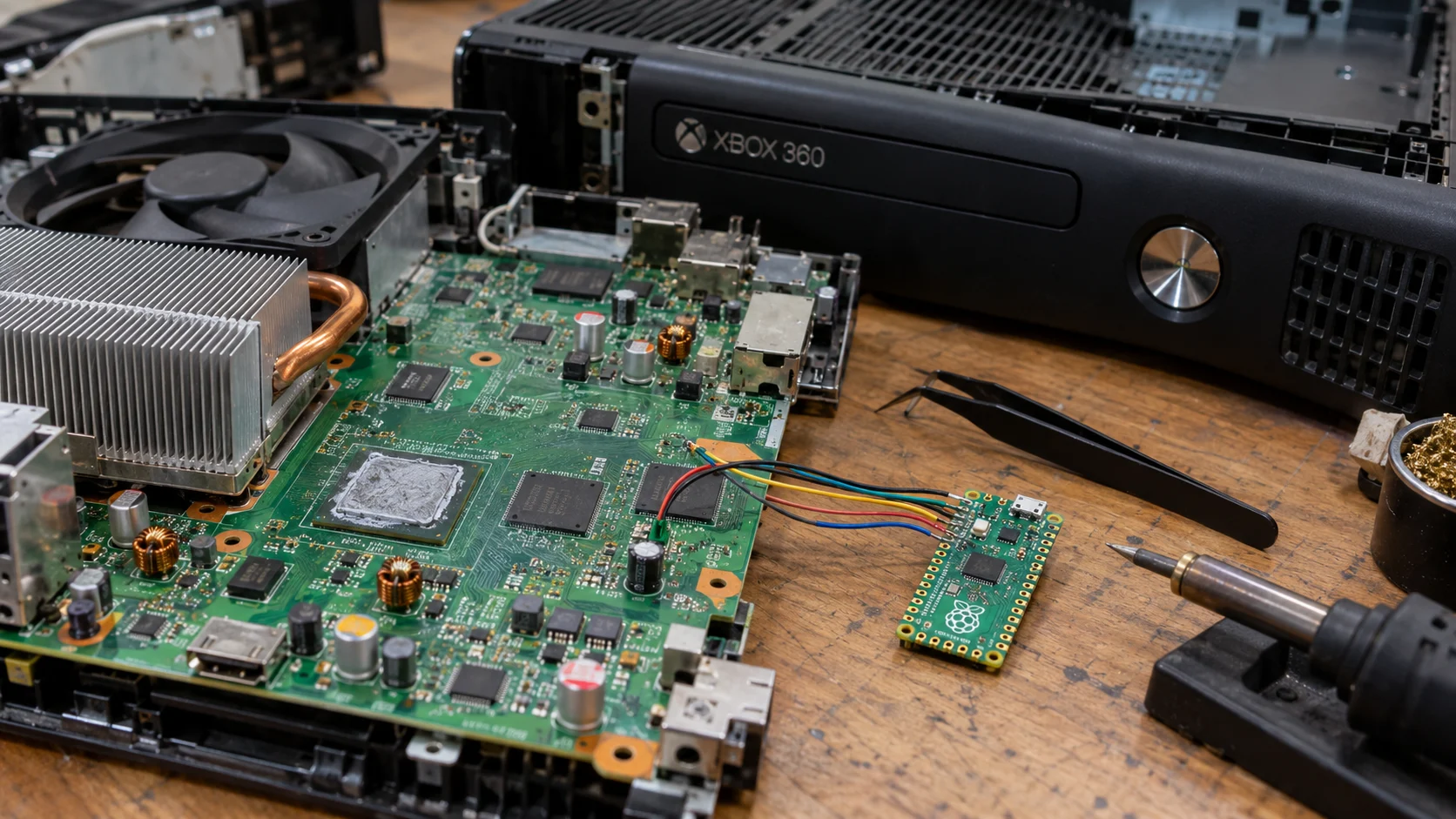
A longtime Xbox 360 modding project has reached a milestone after Scottish developer Joshua Kennedy revisited a hardware-based security bypass with the help of an inexpensive Raspberry Pi Pico microcontroller. The project, which began in 2017, demonstrates how affordable hardware tools have made certain complex console-modding tasks more accessible in 2026.
Kennedy documented the achievement in a blog post published on October 8, 2026. The project later attracted attention from gaming and hardware publications, highlighting the continued interest in modifying Microsoft’s nearly two-decade-old console.
How the Xbox 360 Voltage Glitch Mod Works
The Xbox 360 voltage glitch mod relies on a hardware technique known as a reset glitch. Rather than breaking Microsoft’s cryptographic protections directly, the technique exploits the way a processor behaves when a carefully timed signal interrupts its normal operation.
The console’s boot process includes security checks designed to verify that critical software components are authorized. Under very specific timing conditions, a brief reset-related signal can cause the processor to execute an instruction incorrectly. Researchers discovered that this behavior could interfere with part of the boot verification process and make it possible to run unsigned code.
The method is timing-sensitive. The successful signal must occur within a narrow window, and different Xbox 360 hardware revisions can behave differently. That makes the approach considerably more complicated than installing ordinary software.
Why the Raspberry Pi Pico Made a Difference
Kennedy originally purchased a Matrix CoolRunner Rev D glitch chip in 2017. At the time, completing the project required several specialized tools, including equipment for accessing the console’s NAND flash storage and programming the hardware used to trigger the glitch.
The project was eventually shelved after the original attempt failed to come together.
Kennedy returned to it in 2026 with a Raspberry Pi Pico, an inexpensive microcontroller based on the RP2040 chip. The Pico was used to handle important supporting tasks, including reading the console’s NAND flash data and programming timing files for the existing Matrix CoolRunner.
The process used PicoFlasher to access the console’s NAND interface. Kennedy also used Pico-dirtyJTAG and additional software tools to program the glitch chip with timing files associated with the Xbox 360 modding community.
A particularly useful feature of the Pico is its programmable input/output hardware, which supports precise timing operations. Kennedy explained that its 133 MHz clock provides an effective timing resolution of approximately 7.5 nanoseconds for the operations discussed in the project.
That precision helped simplify a workflow that had previously presented a significant technical challenge.
Does the $4 Raspberry Pi Pico Do Everything?
No. The low-cost microcontroller is an important part of the achievement, but describing the entire modification as a $4 project would be misleading.
The Pico replaced or simplified parts of the earlier tooling process, particularly the work involved in reading NAND data and programming the glitch chip. The project still relied on the Matrix CoolRunner Rev D, physical connections to the console, compatible timing files, and the technical knowledge needed to complete the modification.
The actual cost also depends on the tools and components a person already owns, the console’s motherboard revision, and the availability of suitable hardware. The headline price refers to the microcontroller, not the complete cost of every part needed for an installation.
Hardware Revision and Reliability Still Matter
An Xbox 360 voltage glitch mod is not a universal, one-size-fits-all modification. Different motherboard revisions can require different timing configurations, and a setup that works on one system may not work reliably on another.
The established Reset Glitch Hack family includes several methods, such as RGH 1.2 and RGH 3. RGH 3 can be simpler in terms of hardware requirements, but community documentation warns that some older Xbox 360 models can experience inconsistent booting or other compatibility problems.
Hardware modifications also carry a risk of damaging the motherboard or leaving the console unable to boot. Anyone considering an installation should identify the exact console revision and understand the recovery requirements before making changes.
The project is best understood as a demonstration of improved diagnostic and programming tools rather than proof that every Xbox 360 can now be modified easily.
A Software-Based Xbox 360 Mod Is Also Drawing Attention
The voltage glitch project arrives amid renewed interest in alternative ways to run homebrew software on the Xbox 360. A separate community project called Peer Pressure has also attracted attention for its persistent software-based modification approach.
Unlike the voltage glitch method, Peer Pressure relies on software and changes involving the console’s storage rather than a dedicated glitch chip. Its developer documents support for several Xbox 360 motherboard revisions, while noting that Corona and Winchester systems are not supported.
The two approaches are technically different. The Raspberry Pi Pico project demonstrates how inexpensive tools can simplify a hardware-based modification, while Peer Pressure represents a separate software-based route. Neither development should be treated as universally compatible with every Xbox 360.
Why the Achievement Matters for Retro Gaming
The Xbox 360 remains an important platform for retro-gaming enthusiasts, homebrew developers, hardware researchers, and console preservation projects. Its security architecture was designed to restrict unauthorized software, but years of research have produced multiple ways to investigate and modify the system.
Kennedy’s nine-year project illustrates how the availability of inexpensive microcontrollers and better community-developed tools can change the difficulty of older hardware projects. A task that proved impractical in 2017 became achievable when the developer returned with a more accessible toolkit in 2026.
The broader lesson extends beyond one console: affordable hardware is making specialized experimentation more approachable, even when the underlying security mechanisms remain technically demanding.
For Xbox 360 owners, the important distinction is that the achievement concerns the tools used to complete one particular modification. Console compatibility, installation complexity, reliability, and the risk of hardware damage remain essential considerations.