
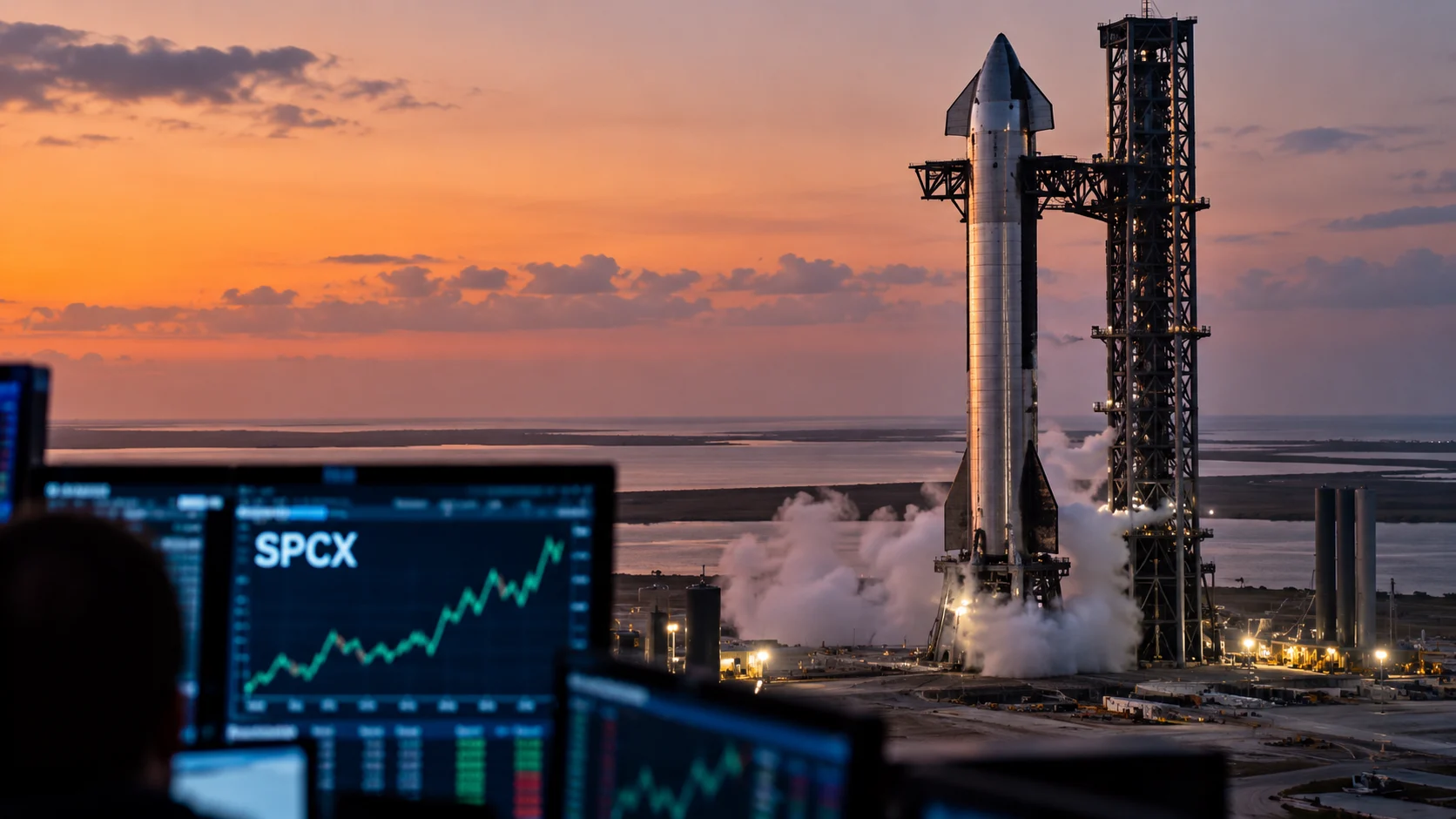
October 15, 2026 — SpaceX shares fell again on Thursday as renewed pressure across technology and artificial intelligence stocks weighed on investor sentiment. Investors are also assessing the company’s expanding ambitions in artificial intelligence, its growing capital requirements, and its plan to enter the U.S. wireless market through Starlink Mobile.
Space Exploration Technologies Corp. trades on the Nasdaq Global Select Market under the ticker symbol SPCX. At approximately 12:56 p.m. Eastern Daylight Time on Thursday, the stock traded near $146.09, down about 4% from Wednesday’s closing price of $152.16. The shares had fallen as low as approximately $140.70 during Thursday’s session, according to market data available at that time.
The decline extended a difficult stretch for the stock. SPCX dropped 2.80% on Wednesday and 4.21% on Tuesday, putting the shares approximately 10.6% below their October 12 closing price of $163.42 by Thursday afternoon.
The sell-off comes as investors reconsider the valuations of companies with significant artificial intelligence exposure and substantial spending commitments. However, broader market weakness does not establish a single cause for SpaceX’s share-price movement, and the company’s long-term performance will depend on its financial results, execution, and ability to turn investments into sustainable earnings.
Why Is SpaceX Stock Falling?
One important factor is the wider retreat in technology and AI-related shares. Recent U.S. inflation data has raised concerns about the possibility of higher interest rates, while investors are questioning whether the revenue growth expected from expensive AI infrastructure projects will justify the money being invested in them.
Higher borrowing costs can make capital-intensive projects more expensive to finance. They can also reduce the present value investors assign to future earnings, placing additional pressure on companies whose valuations depend heavily on long-term growth expectations.
SpaceX operates across several major businesses, including launch services, satellite connectivity through Starlink, and artificial intelligence infrastructure. That combination creates substantial growth opportunities, but it also means investors must evaluate spending and profitability across multiple businesses with different financial requirements.
The company’s latest reported financial results show strong revenue growth and an improving adjusted EBITDA figure. At the same time, SpaceX continues to report a net loss and is spending heavily to expand its technology and infrastructure operations. Those competing factors help explain why investors may respond cautiously even when the business is growing rapidly.
SpaceX’s Latest Financial Results Show Strong Revenue Growth
SpaceX reported second-quarter 2026 revenue of approximately $7.81 billion for the three months ended June 30. That represented an increase of 92% from $4.07 billion in the same period a year earlier, according to the company’s financial results filed with the U.S. Securities and Exchange Commission.
The company reported a net loss of $541 million for the quarter, compared with a net loss of approximately $1.01 billion in the second quarter of 2025. The smaller loss represents an improvement in its bottom-line performance, although SpaceX had not yet reported a GAAP net profit for that quarter.
Adjusted EBITDA, a non-GAAP measure of operating performance, increased to approximately $3.54 billion from $1.21 billion a year earlier. This measure provides additional information about operating performance, but it does not replace net income or account for every expense that affects shareholders.
SpaceX’s results also highlight how significantly its artificial intelligence operations are expanding. The AI segment generated approximately $2.56 billion in second-quarter revenue, up from $737 million in the comparable period of 2025. However, the segment recorded an operating loss of approximately $1.26 billion, reflecting the costs associated with its expansion.
Capital expenditures across the company reached approximately $18.37 billion during the second quarter, compared with $2.83 billion in the same quarter of the previous year. The substantial increase underscores the scale of SpaceX’s infrastructure investment and gives investors another important figure to monitor as the company pursues expansion across space, connectivity, and AI.
Starlink Remains a Major Part of the SpaceX Investment Story
Starlink continues to be one of SpaceX’s most important growth businesses. Its satellite broadband network provides internet connectivity to consumers, businesses, airlines, and government customers, while its expanding subscriber base creates opportunities for recurring revenue.
SpaceX reported 12 million Starlink subscribers at the end of the second quarter of 2026, double the number recorded a year earlier. Connectivity revenue reached approximately $4.29 billion, an increase of 66% from the second quarter of 2025.
The connectivity segment also reported operating income of approximately $1.66 billion for the quarter. That performance contrasts with the operating loss in the AI segment and illustrates why investors may evaluate SpaceX’s individual businesses differently rather than treating the company as a single, uniform growth operation.
Starlink’s future performance will depend on continued subscriber growth, service quality, network capacity, pricing, and demand from commercial and government customers. The company’s ability to maintain growth while funding its next-generation satellite systems will be important to its longer-term financial outlook.
SpaceX’s $8 Billion Spectrum Deal Could Expand Its Wireless Ambitions
Another important development for SpaceX stocks is the company’s move toward becoming a more direct competitor in the U.S. mobile communications market.
SpaceX has agreed to acquire a nationwide portfolio of low-band wireless spectrum licenses from Grain Management in a transaction valued at approximately $8 billion. The agreement covers up to 14 megahertz of paired spectrum in the 800 MHz band and remains subject to approval by the Federal Communications Commission.
Low-band spectrum is valuable for broad-area coverage because its signals can travel relatively long distances and penetrate buildings more effectively than higher-frequency signals. These characteristics could help SpaceX extend connectivity beyond what satellite coverage alone can consistently provide, particularly in locations where users need a stronger signal indoors.
The company’s proposed Starlink Mobile strategy involves combining satellite connectivity with ground-based infrastructure, including radios and antennas installed on towers and rooftops. The goal is to create a more integrated wireless service that can complement satellite coverage and compete more directly with established mobile operators.
The opportunity is potentially significant, but the acquisition does not automatically create a nationwide mobile network. Regulatory approval, network deployment, service reliability, customer acquisition, and the cost of building supporting infrastructure will all influence whether the plan becomes a meaningful source of revenue and profit.
The spectrum purchase also adds to the capital and execution questions investors must consider. A successful expansion could open a substantial new market for SpaceX, but the company will need to demonstrate that the additional investment can generate attractive returns over time.
Starlink’s Ukraine Policy Adds Another Area of Investor Scrutiny
SpaceX has also faced renewed attention over the use of Starlink in Ukraine, including restrictions involving the use of its connectivity service by fast-moving drones. The issue has raised questions about the company’s role in a strategically important communications network and the possible reputational implications of decisions about access to its technology.
The financial impact of this issue is not yet established by the publicly available quarterly results. Nevertheless, investors may continue to monitor developments involving government relationships, the company’s international customers, and the policies governing access to Starlink services.
For a company operating across commercial, government, and international markets, these developments represent a different category of risk from the financial pressures associated with AI spending and interest rates. They should be evaluated separately rather than treated as a confirmed explanation for any single day’s share-price decline.
SpaceX Stock: What Investors Should Watch Next
The next stage of SpaceX’s public-market performance will depend on whether its operating growth can translate into sustainable financial results while the company continues investing in new products and infrastructure.
Investors following SPCX should pay particular attention to Starlink subscriber growth, connectivity revenue, the profitability of the AI business, and changes in company-wide capital expenditures. These figures can help show whether its rapidly expanding operations are producing sufficient financial returns to support continued investment.
The status of the proposed spectrum acquisition is another important consideration. Progress toward regulatory approval and further details about the Starlink Mobile rollout could clarify the timetable, costs, and competitive implications of the company’s wireless ambitions.
Future financial disclosures will also help investors assess whether revenue growth is keeping pace with operating expenses, capital spending, and financing requirements. Adjusted EBITDA growth is encouraging, but continued net losses and substantial investment needs remain important parts of the financial picture.
Broader market conditions will matter as well. Persistent inflation, interest-rate expectations, and changing investor sentiment toward AI infrastructure could continue to influence the prices investors are willing to pay for growth-oriented companies.
Are SpaceX Stocks Worth Watching After the Latest Decline?
Thursday’s decline places renewed attention on the balance between SpaceX’s growth prospects and the financial risks associated with its expansion. Starlink is generating substantial revenue, the AI segment is growing rapidly, and the planned wireless expansion could create additional commercial opportunities.
At the same time, SpaceX reported a net loss in the second quarter and made a sharp increase in capital expenditures. Its future performance will depend not only on expanding revenue but also on managing costs, executing major projects, and converting its investments into durable earnings and cash flow.
For investors, a lower share price does not automatically mean a stock is undervalued. The assessment requires comparing the current market price with realistic expectations for future revenue, profitability, capital requirements, and business risks.
SpaceX shares remain sensitive to developments across technology markets and the company’s own operations. The performance of Starlink, the economics of its AI investments, and progress on Starlink Mobile will be important factors to watch as investors assess the company’s long-term prospects.
Market prices are subject to change throughout the trading session. This article is for informational purposes only and does not constitute investment advice.