
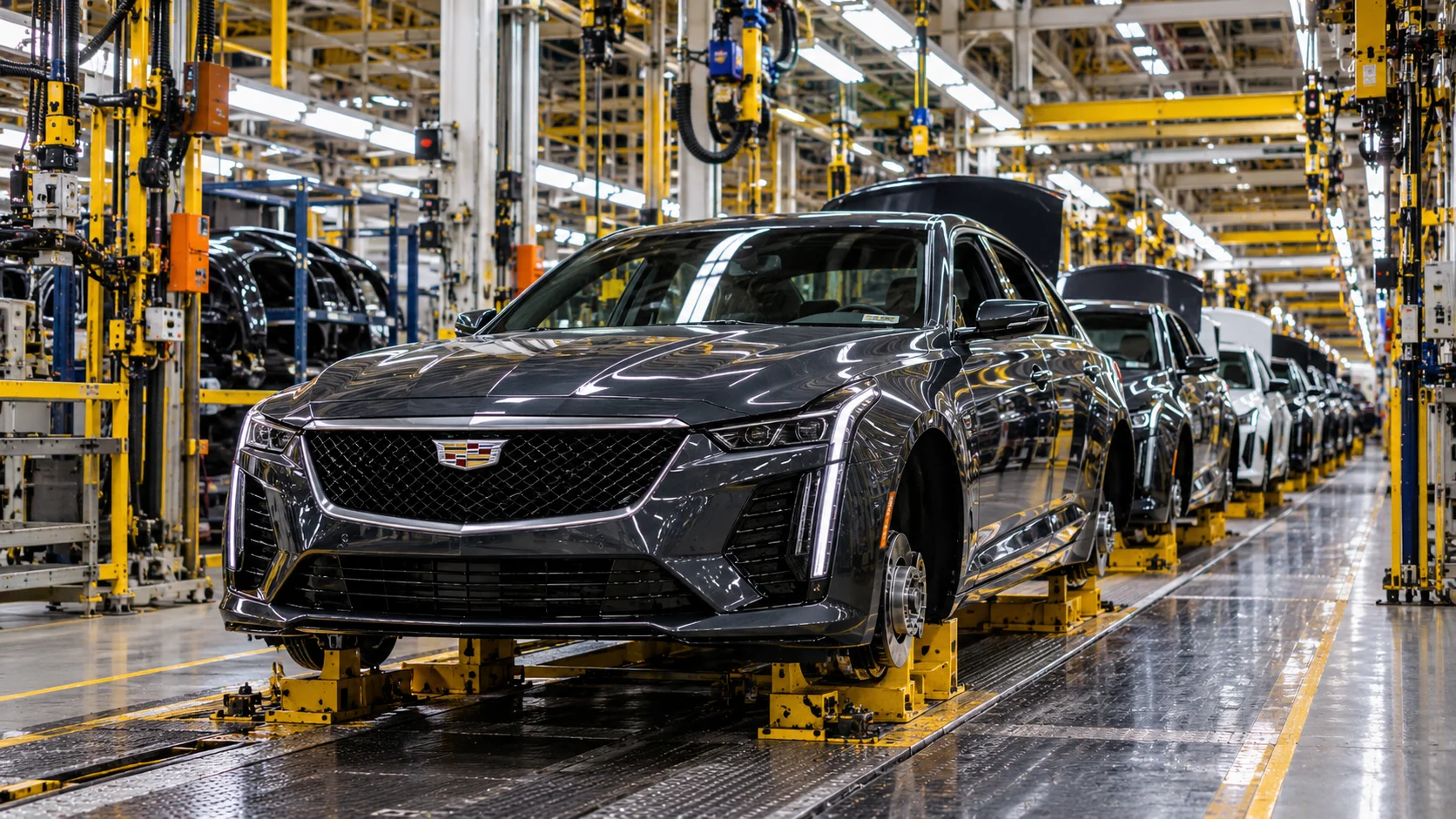
General Motors is preparing its Lansing Grand River Assembly plant in Michigan for a major production transition, with downtime planned for early 2027. Current Cadillac CT5 production is scheduled to end in December 2026, while the next-generation sedan is expected to enter production in the second half of 2028. However, GM has not confirmed that the entire facility will remain idle throughout the period between the two generations.
General Motors’ plans for its Lansing manufacturing operations are drawing fresh attention as the automaker prepares to retool the facility for future vehicle production. The transition is connected to the next-generation Cadillac CT5, which GM has confirmed will continue as a gasoline-powered model built at the Michigan plant.
The potential production gap has raised questions about how the factory will operate during the transition, what the changes mean for employees, and when vehicle assembly will resume. While reports have discussed a possible 18-month gap in vehicle production, that does not establish that every operation at the facility will be suspended for the entire period.
When Will Cadillac CT5 Production End?
The current-generation Cadillac CT5 is scheduled to end production at Lansing Grand River in December 2026. The sedan is the plant’s remaining Cadillac model following the discontinuation of the CT4 earlier in 2026.
GM has identified Lansing Grand River as the manufacturing location for the next-generation CT5, signaling that the automaker intends to preserve the sedan’s place in its future lineup. The upcoming model is expected to use an internal-combustion powertrain rather than making the transition to an all-electric vehicle.
Industry reporting has placed the next-generation CT5’s anticipated production start in the second half of 2028, potentially as a 2029 model. GM has not publicly established a definitive restart date that confirms the length of the production gap.
Why Is GM Planning a Production Pause?
The planned downtime is tied to retooling work intended to prepare Lansing Grand River for future vehicle programs. General Motors previously announced a $1.25 billion investment associated with preparing the facility for future production, including the next-generation Cadillac CT5.
The plant’s production strategy has evolved since GM initially planned to adapt the facility for electric vehicle manufacturing. As the company’s product plans have changed, the next phase of investment is expected to support future vehicle production, including another generation of the gasoline-powered CT5.
Retooling an automotive plant can involve equipment changes, manufacturing-line modifications, tooling installation, and other preparations needed to build a new vehicle. The scope and duration of the Lansing project, however, should not be confused with a confirmed period of complete factory closure.
GM Layoffs and Employee Impact
General Motors has also announced plans affecting approximately 350 employees across two Lansing-area facilities: Lansing Grand River Assembly and Lansing Regional Stamping. According to reporting on the Michigan Worker Adjustment and Retraining Notification filing, the layoffs are scheduled to take effect on January 14, 2027.
GM has said affected employees may have opportunities to transfer to other company facilities or qualify for supplemental unemployment pay equivalent to 74% of their hourly wages under the applicable General Motors-United Auto Workers agreement.
The automaker has also indicated that it anticipates recalling affected employees to Lansing Grand River when the retooling period ends. The announced workforce changes therefore should not automatically be interpreted as confirmation of a permanent plant closure.
Will the Lansing Cadillac Plant Remain Closed for 18 Months?
The possibility of an extended production pause remains an important question, but the available information does not confirm that the whole Lansing Grand River facility will stop all operations for 18 months. A gap between the current CT5’s final production and the next generation’s anticipated arrival does not necessarily mean every manufacturing activity will cease during that time.
GM has not publicly detailed a complete month-by-month operating schedule for the facility during the transition. Further information about retooling milestones, employee assignments, and future production plans will be important in determining how the plant is used before the next CT5 begins assembly.
Reports have also discussed the possibility of additional future vehicle programs at the facility, but potential models should not be treated as confirmed production assignments without an announcement from GM.
What the GM Cadillac Assembly Plant Pause Means for the CT5
For Cadillac, the transition represents a planned change between generations rather than an announced end to the CT5 nameplate. GM has confirmed that a next-generation, gasoline-powered CT5 will be produced at Lansing Grand River, although its final specifications, launch schedule, and full production details remain subject to future announcements.
For Lansing employees and the surrounding supply chain, the immediate issues are the planned downtime, the January 2027 workforce changes, and the timing of future manufacturing activity. The eventual restart schedule will determine how long the transition affects local vehicle production.
As of October 19, 2026, the key confirmed points are that current CT5 production is scheduled to end in December, retooling-related downtime is planned for early 2027, and GM intends to build a next-generation CT5 at Lansing Grand River. An 18-month period without vehicle production remains a possibility discussed in industry reporting, not a confirmed full-facility shutdown lasting that entire time.