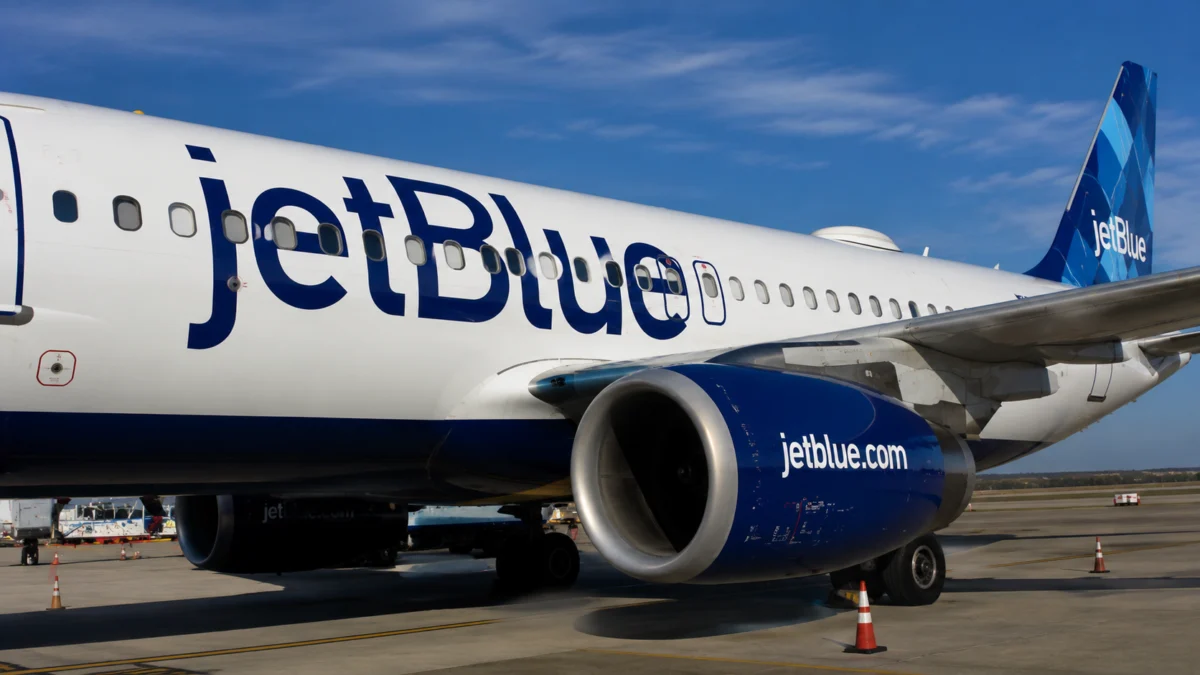
JetBlue Airways shares are giving back some ground in early Wednesday trading, a day after the stock jumped 10.5% to close at $6.00 on the back of a second-quarter earnings beat and a new long-term profit target. As of 5:55 a.m. ET, the stock was indicated around $5.84, down 2.65% from Tuesday’s close, according to CNN Markets.
The pullback follows a session that had little to do with pessimism. JetBlue’s second-quarter results, filed Tuesday, showed revenue climbing 14.5% year-over-year to $2.7 billion, edging past the roughly $2.69 billion analysts had penciled in. The adjusted loss came in at $0.66 per share, narrower than the $0.70 loss Wall Street expected.
None of that offsets the number that actually moved the model: fuel.
JetBlue spent $911 million on jet fuel in the quarter — up nearly 81% from a year earlier — as the average price per gallon rose to $4.23 from $2.40. That single line item swallowed the entire revenue gain and then some, pushing the net loss to $247 million, wider than the $74 million loss booked in the same quarter last year.
The mechanism is straightforward and it’s the one every airline earnings call now runs through. Jet fuel typically makes up somewhere between a fifth and a third of an airline’s operating costs. When the price per gallon rises 80% in a single quarter, it doesn’t matter how much traffic or pricing power a carrier adds — the fuel line grows faster than almost anything else on the income statement can offset it. JetBlue’s management said Tuesday it recaptured nearly 50% of that higher cost through fares and cost actions, ahead of the 30% to 40% pace it had guided to. Full recapture, the company said, is targeted for early 2027.
That recapture number is the reason the stock didn’t sell off Tuesday despite a wider loss. It’s also the reason the long-term target management introduced landed as credible rather than aspirational: JetBlue is now guiding to at least $1.00 in earnings per share for 2028, built on continued demand strength and an assumed fuel price of $3.00 a gallon that year — a full $1.23 below what it just paid in Q2.
“Our second quarter performance reflects the strength of our JetForward strategy and the focused execution of our crewmembers, as strong customer demand and our decisive actions enabled us to recover fuel costs more quickly than we anticipated,” JetBlue chief executive Joanna Geraghty said in the company’s earnings release.
Worth sizing that 2028 target against where the stock trades now. At a pre-market indication near $5.84, JetBlue carries a market capitalization of roughly $2.2 billion. A $1.00 EPS target against 377 million shares outstanding implies close to $377 million in annual net income three years out — a swing of well over $600 million from where the company sits today. That’s the scale of turnaround the market is being asked to underwrite, and it’s contingent on a fuel assumption running below where prices have sat for most of 2026.
JetBlue’s turnaround program, branded JetForward, has generated an estimated $470 million in cumulative incremental earnings before interest and taxes through June, the company said. Management is targeting $850 million to $950 million in annual incremental EBIT by the end of 2027, and roughly $1.2 billion in 2028 — the backbone of the profitability case.
Wall Street’s response has split along familiar lines. CNN’s markets desk reported that Morgan Stanley raised its price target on the stock, citing the 2028 guide as a confidence signal, while BofA kept its Underperform rating intact even after the earnings beat. Citi, separately, raised its target to $6.60 from $4.40 as part of its own post-earnings note, according to StockAnalysis.com‘s compiled ratings history. The split isn’t unusual for a stock still carrying negative trailing earnings and a P/E ratio that doesn’t compute — it just means the 2028 target is being read as a plan, not yet a forecast anyone is fully pricing in.
There’s a sector angle here too. JetBlue’s rally on Tuesday pulled peers with it — Delta and United both moved higher the same day on what one report described as JetBlue’s demand read carrying over to the group, a reminder that fuel and fare dynamics this quarter aren’t JetBlue-specific.
The next real test isn’t another earnings print. It’s the fuel tape itself. JetBlue’s full-year 2026 guidance assumes $3.49 per gallon — already below the $4.23 it paid in Q2, and management is betting the second half looks more like that lower number. If crude holds where it’s been trading, JetBlue’s recapture math keeps working. If it doesn’t, the 2028 target starts sliding the way plenty of long-dated airline guidance has before.

