
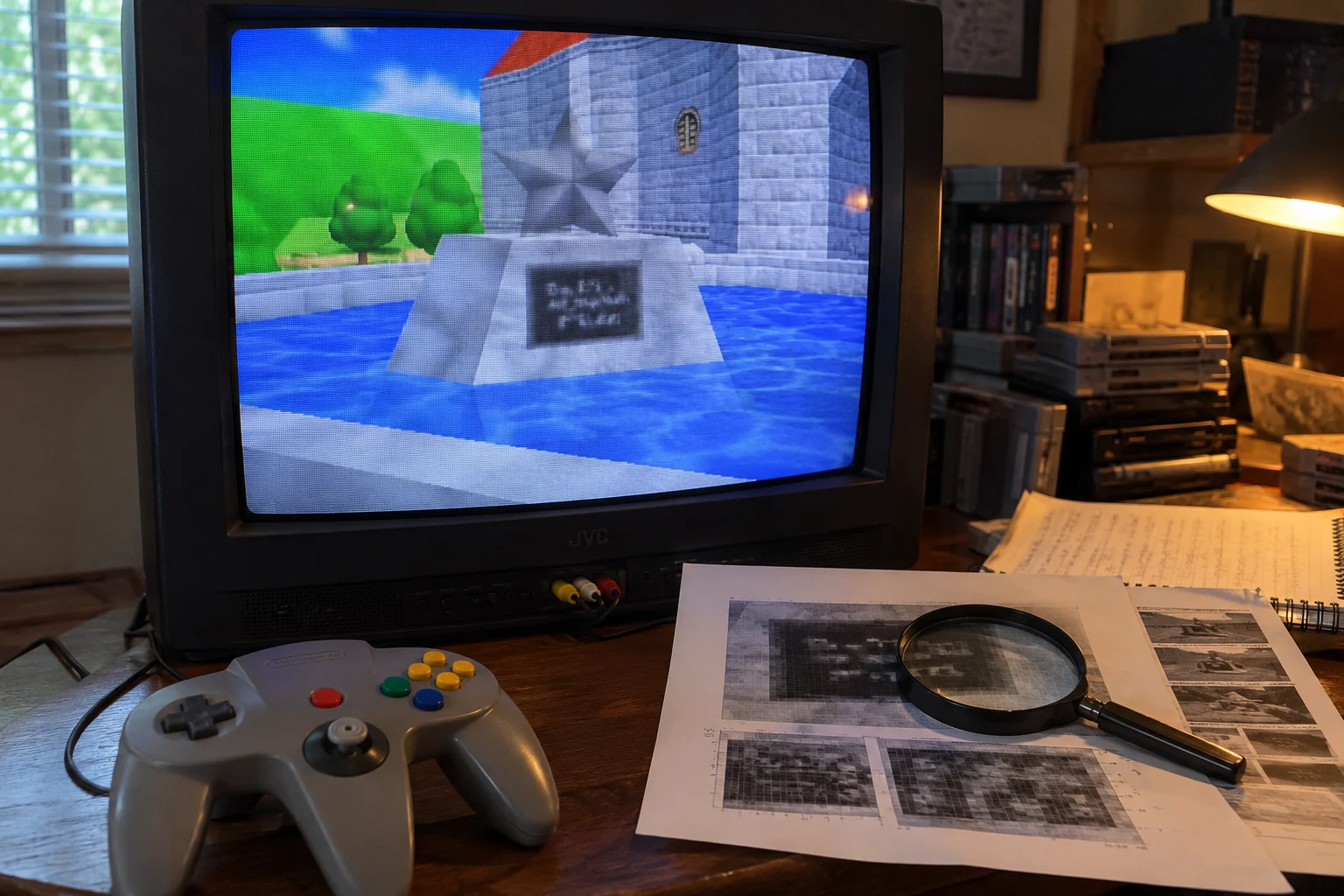
A decades-old mystery in Super Mario 64 may finally have a convincing explanation. A new computational analysis of the game’s famously blurry courtyard plaque suggests that its inscription reads “Eternal Star” on the first line and “We hope so” on the second, challenging the long-running fan theory that the text says “L is real 2401” and hints at a hidden appearance by Luigi.
The findings come from an independent, open-source research project published by a programmer known as Mochi64, who investigated the tiny inscription using image reconstruction, font analysis, and computational testing. Although the results provide a strong new interpretation of the plaque, Nintendo has not officially confirmed what the original text was intended to say.
Released for the Nintendo 64 in 1996, Super Mario 64 features the plaque on the base of a star statue in the courtyard outside Princess Peach’s Castle. Its lettering is almost impossible to read clearly because the original texture measures just 32 by 32 pixels, with individual letters only about three to five pixels tall.
For years, players have tried to decipher the inscription by enlarging screenshots, adjusting contrast, and comparing different visual interpretations. One of the most popular theories claims that the plaque reads “L is real 2401,” potentially suggesting that Luigi could be unlocked as a secret playable character. The rumor gained wider attention through gaming discussions and a 1998 Nintendo Power April Fools’ feature, but the inscription was never established as proof of a hidden Luigi unlock.
How the Super Mario 64 Plaque Analysis Works
Rather than relying on traditional image enhancement, Mochi64 approached the problem as a reconstruction exercise. The key idea was to simulate how a game artist working in the mid-1990s might have created the plaque’s lettering, then compare those simulated results with the original pixels extracted from the game.
The project tested combinations of candidate words, fonts, text spacing, image resizing, blur, and other rendering settings. It also examined typefaces that would have been available to designers during the game’s development era. A graphics processor evaluated large numbers of possible combinations, while the open-source project documented the methodology and results for further investigation.
According to the analysis, Adobe’s 1990 version of Palatino Bold Italic produced the closest overall match among the tested font options. The reconstruction favored “Eternal Star” for the upper line and “We hope so” for the lower line. The proposed wording is therefore not simply the result of enlarging the original image; it is a hypothesis based on how well a recreated piece of text matches the surviving texture.
The project also compared the famous “L is real 2401” interpretation against its preferred reconstruction. Under the reported scoring method, the Luigi-related phrase fit the first line substantially worse than “Eternal Star.” This result weakens the case for treating the plaque as a secret character clue, although it does not establish what Nintendo’s original artists intended with absolute certainty.
Does the Analysis Finally Solve the Luigi Mystery?
The new evidence gives the “Eternal Star” interpretation a stronger technical foundation than previous attempts based mainly on visual guesswork. However, the researchers’ conclusion still depends on assumptions about the original font, artwork, and rendering process. Extremely low-resolution images can leave room for ambiguity, and a good computational match is not the same as direct confirmation from the people who created the asset.
The wording also deserves some caution. The project’s results support “Eternal” and “Star” strongly, while “hope” is another well-supported reading. “We” is supported, too, but the final word “so” has a smaller margin over alternative readings. That distinction matters because the method ranks candidate phrases by how closely they match the available pixels rather than recovering a perfectly readable original image.
Luigi’s connection to Super Mario 64 is not entirely fictional. Series creator Shigeru Miyamoto discussed plans for a multiplayer mode involving Mario and Luigi during development, but those plans did not make Luigi an unlockable character in the finished Nintendo 64 game. The plaque theory grew out of fans’ interest in those cut features, not from verified evidence that the inscription contained unlocking instructions.
By making its code, results, and analysis available for examination, Mochi64’s project gives other researchers a way to test competing readings instead of relying on speculation alone. Independent verification could help determine whether the same method consistently favors the proposed inscription or whether another plausible reconstruction can produce a better match.
For now, the latest Super Mario 64 plaque analysis offers a compelling new explanation for one of gaming’s most persistent visual mysteries. “Eternal Star / We hope so” is the leading interpretation from this research, but until Nintendo or someone directly involved in creating the original artwork confirms it, the inscription’s intended meaning remains unverified.