
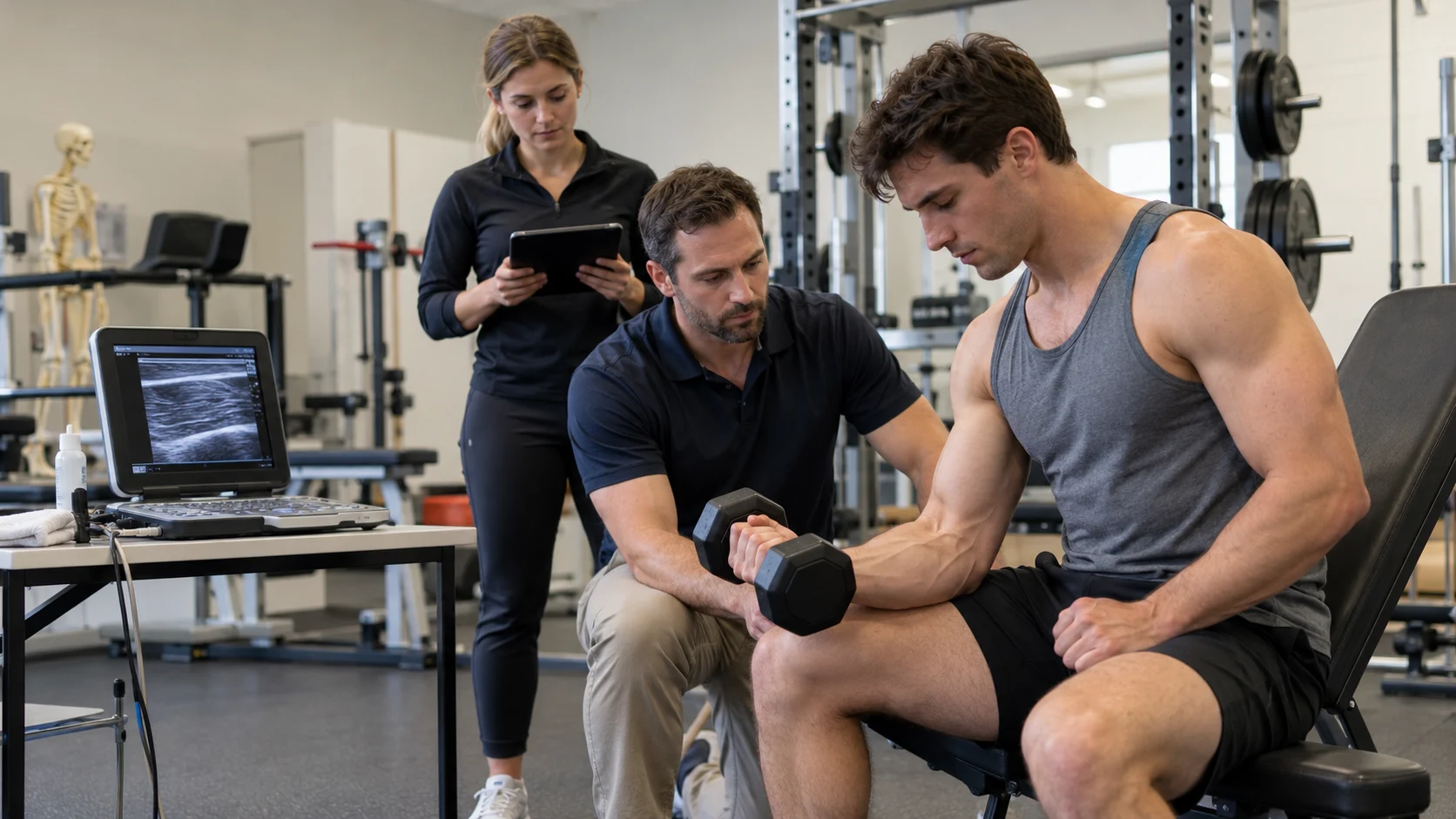
New research involving exercise scientist Milo Wolf is adding to the debate over how exercise technique influences muscle growth. A study published in Frontiers in Physiology on March 31, 2026, examined whether changing shoulder position during cable curls produces greater growth in the biceps and other elbow flexor muscles.
The findings suggest that a more stretched shoulder position does not necessarily lead to greater muscle growth when other important training variables are controlled. Both training variations increased muscle thickness, but researchers found no meaningful difference between them.
The results offer a useful lesson for people trying to build bigger arms: exercise technique matters, but changing a single joint position does not automatically deliver better results.
What Did Milo Wolf’s 2026 Muscle Growth Research Examine?
The study, titled “The Effects of Shoulder Extension Angle on Elbow Flexor Hypertrophy in the Cable Curl Exercise,” investigated whether performing cable curls with the shoulder in a more extended position could produce greater muscle growth than performing the exercise with the shoulder in a neutral position.
The researchers initially enrolled 30 untrained men, of whom 24 completed the 10-week intervention. Each participant trained one arm using a neutral shoulder position and the other using an individualized, more extended shoulder position.
The researchers carefully matched the resistance profiles and elbow range of motion between the two conditions. Participants performed six to eight weekly sets of unilateral cable curls, training to momentary muscular failure under supervision.
Muscle thickness was measured using ultrasound at two locations along the upper arm before and after the intervention. This allowed the researchers to compare changes in the elbow flexor muscles rather than relying only on changes in body weight or arm circumference.
Both Cable Curl Variations Increased Muscle Thickness
The study found that both training conditions produced increases in elbow flexor muscle thickness of approximately 7% to 9% over the intervention period.
However, the statistical analysis did not identify a meaningful difference between the two shoulder positions. When resistance characteristics, elbow movement and training effort were matched, placing the shoulder in a more extended position did not appear to provide an additional muscle-growth advantage in the participants studied.
These findings do not mean that shoulder position is irrelevant to every exercise. Instead, they suggest that shoulder extension alone may not be enough to create substantially different growth outcomes when other training variables are controlled.
The distinction is important because different curl variations can change several variables simultaneously, including muscle length, joint mechanics and the amount of resistance experienced at different points in a repetition. Without controlling these factors, it can be difficult to determine which aspect of an exercise is responsible for any observed difference in muscle growth.
Does Training at Longer Muscle Lengths Build More Muscle?
Milo Wolf has also contributed to research investigating whether resistance training at longer muscle lengths can produce greater muscle growth than training at shorter muscle lengths.
A systematic review published in Sports Medicine and Health Science, with an issue date of January 2026, examined the evidence on longer-muscle-length resistance training and longitudinal muscle growth.
The review included eight studies involving a total of 120 adults. The researchers compared training performed at longer muscle lengths with training performed at shorter muscle lengths, examining changes in muscle size and estimated muscle fascicle length.
The results suggested that training at longer muscle lengths may produce greater increases in muscle size and fascicle length in some circumstances. However, the evidence was mixed, and the researchers highlighted important limitations in the available studies.
For example, most studies used indirect calculations to estimate muscle fascicle length, and the review found that these estimation methods had questionable validity. The researchers also noted that the underlying structural changes responsible for the observed adaptations remained uncertain.
Consequently, the review supports further investigation into longer-muscle-length training rather than establishing that every exercise performed in a stretched position will produce superior results.
What Does Other Recent Research Say About Lengthened Partial Repetitions?
Research published in 2026 has also examined lengthened partial repetitions, a technique in which lifters perform repetitions through the portion of an exercise that keeps the target muscle relatively lengthened.
A separate systematic review and meta-analysis published in Sport Sciences for Health in January 2026 examined partial-range resistance training performed at longer versus shorter muscle lengths. The analysis included eight studies and reported a small average hypertrophy advantage for training at longer muscle lengths.
These findings provide additional support for investigating the role of muscle length during resistance training. However, this research addressed a different comparison from the cable curl study involving Milo Wolf. Comparing partial repetitions at different muscle lengths is not the same as isolating shoulder position while matching resistance characteristics and elbow range of motion.
Taken together, these studies indicate that muscle length may influence hypertrophy, but the effect depends on the exercise, the training conditions and the specific comparison being investigated.
What Are the Limitations of the Cable Curl Study?
Although the findings provide useful information, several limitations should be considered before applying them to every resistance-training program.
- Small sample size: Only 24 participants completed the intervention, limiting how confidently the findings can be generalized to larger populations.
- Participant characteristics: The study involved untrained men, so the results may not apply directly to experienced bodybuilders, trained women or other populations.
- Short duration: The intervention lasted 10 weeks. Longer studies may reveal different patterns of adaptation.
- Specific exercise: The researchers examined cable curls under controlled conditions. The findings do not establish that shoulder position has no effect on every biceps exercise or other muscle group.
The absence of a meaningful difference between the two conditions should also not be interpreted as proof that the methods are identical in every situation. It means that this particular study did not establish a practically meaningful advantage for the more extended shoulder position under the conditions tested.
How Can Lifters Apply These Findings to Their Workouts?
For people looking to increase biceps size, the research suggests that there is no compelling reason to assume that one shoulder position during cable curls will automatically produce greater growth.
Instead, lifters can select a curl variation that allows them to train with controlled technique, use a comfortable range of motion and apply sufficient effort consistently. Increasing repetitions or resistance over time, while maintaining appropriate form, can help create a progressive training stimulus.
It is also important to evaluate an exercise as a whole rather than focusing exclusively on the position of a single joint. Muscle length, resistance throughout the movement, training volume, effort and recovery can all influence the effectiveness of a resistance-training program.
People experiencing shoulder, elbow or wrist pain should avoid forcing a joint into an uncomfortable position simply to imitate a particular exercise technique.
The Bottom Line on Milo Wolf’s Muscle Growth Research
The 2026 cable curl study involving Milo Wolf found that both neutral and more extended shoulder positions increased elbow flexor muscle thickness over 10 weeks, without a meaningful difference between the conditions.
Other research suggests that training at longer muscle lengths and performing lengthened partial repetitions may offer hypertrophy benefits in some situations. However, the available evidence does not support treating one exercise position as universally superior.
For lifters, the practical takeaway is to focus on consistent resistance training, appropriate effort, progressive overload and sound exercise technique. Research into muscle length can help refine a training program, but no single adjustment to a curl is a guaranteed shortcut to bigger arms.